How to Bet Rugby: The Complete Guide to Rugby Betting in 2026
Updated October 2026
Licensed
Available in US
Fast payouts
18+ Only
Master the art and science of rugby betting with proven strategies, market analysis, and expert techniques for both union and league.
Introduction to Rugby Betting
Rugby betting occupies this fascinating middle ground between brutal physicality and strategic precision. You've got 30 massive humans smashing into each other for 80 minutes straight, yet underneath all that controlled chaos lies a sport that rewards calculated thinking. That's exactly why betting on rugby works so wellâ€"the action never stops long enough for you to get bored, but there's enough tactical depth to give smart money an edge.
If you've been betting on football or basketball and think you can just transfer those skills straight across, I need to stop you right there. Rugby is different. Not harder, not easier, just different in ways that matter when you're putting money on the line. The scoring system aloneâ€"with tries worth five points, conversions adding two more, and penalties or drop goals chiming in at threeâ€"creates opportunities that simply don't exist in other sports.
What really sets rugby betting apart is the continuous flow. There are no timeouts for coaches to reset strategy, no commercial breaks that kill momentum. When a team gets hot, they stay hot. When weather turns nasty midway through, it affects everything from that moment forward. This creates a dynamic betting environment where patience gets rewarded and knee-jerk reactions get punished.
The growth in rugby betting has been remarkable over the past decade. What used to be a niche market dominated by die-hard fans has exploded into mainstream territory. Online sportsbooks now offer 50-plus markets on major matches, live streaming makes every game accessible, and mobile apps let you bet from the stadium itself. The infrastructure has caught up with demand.
This guide cuts through the noise. You'll learn the fundamental differences between rugby union and rugby league that actually affect your betting decisions. We'll break down every major market type with real examples, not theoretical nonsense. The strategies section focuses on actionable approaches you can implement today, whether you're betting on the Six Nations or your local club competition. Advanced techniques come later for those ready to level up.
Understanding Rugby: Union vs League
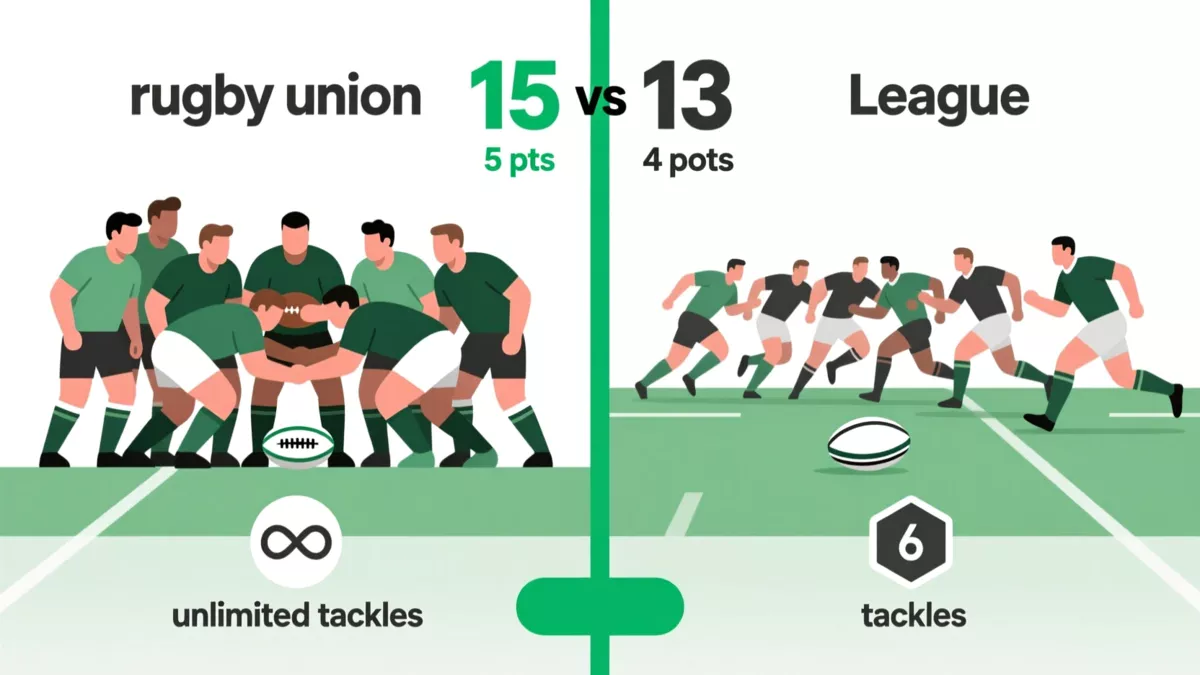
Here's where most newcomers trip up immediately. They see "rugby" and assume it's all the same sport. Wrong. Rugby union and rugby league split in 1895 over payments to players, and that bitter divorce created two distinct codes with different rules, scoring systems, and tactical approaches. If you don't understand these differences, you'll make expensive mistakes.
Key differences between Rugby Union and Rugby League that impact betting decisions
Rugby Union Essentials
Rugby union is the version most people think of when they hear "rugby." Fifteen players per side, proper scrums that actually contest for the ball, lineouts when it goes out of bounds, and unlimited tackles before possession changes. The game flows through phases of play where teams retain the ball through multiple rucks and mauls, building pressure until they either score or lose possession.
The scoring system rewards different types of play. Tries are worth five pointsâ€"these happen when a player touches the ball down in the opponent's in-goal area. After a try, the scoring team attempts a conversion kick from a position perpendicular to where the try was scored, adding two more points if successful. This means most tries are actually worth seven points total, though difficult angle conversions sometimes get missed.
Penalty kicks and drop goals both add three points. Penalties get awarded for rule infractions, and teams can choose to kick for goal from where the penalty occurred. Drop goals happen during open play when a player drops the ball and kicks it as it bounces, sending it through the uprights. These three-pointers often decide tight matches, especially in international rugby where defenses are rock solid.
The major competitions in union include the Six Nations (Europe's annual championship featuring England, France, Ireland, Italy, Scotland, and Wales), the Rugby Championship (Southern Hemisphere's version with Argentina, Australia, New Zealand, and South Africa), and the Rugby World Cup every four years. Club competitions like England's Premiership, France's Top 14, the United Rugby Championship, and Super Rugby provide weekly betting opportunities throughout the season.
Rugby union allows unlimited tackles before possession must change hands, which creates these long, grinding sequences where teams work through multiple phases. A team might retain possession for 20-30 phases, slowly advancing up the field. This tactical approach affects totals betting significantlyâ€"you'll see more varied scoring patterns compared to league.
Rugby League Fundamentals
Rugby league strips away some of union's complexity while adding its own wrinkles. Thirteen players per side instead of fifteen, and here's the huge difference: teams get six tackles to make progress before they must surrender possession. This six-tackle rule fundamentally changes the game's rhythm and strategy.
Scoring differs slightly but meaningfully. Tries are worth four points instead of five, while conversions still add two. Penalty goals drop to two points, and drop goals are worth just one point. These adjustments might seem minor, but they significantly impact margin betting and totals markets. A typical rugby league scoreline looks quite different from a union match.
The six-tackle rule creates a predictable structure. Teams use their first four or five tackles to advance down the field, then kick on the final tackle to either contest for possession or force the opposition back. This structured approach makes rugby league higher-scoring on average and creates different betting opportunities, particularly in live markets where you can track tackle counts.
Major rugby league competitions include the NRL in Australia (the premier league globally), England's Super League, and the spectacle that is State of Originâ€"three matches between Queensland and New South Wales that represent the pinnacle of rugby league intensity. These Origin matches create unique betting scenarios with sky-high intensity and unpredictable outcomes.
The ball used in league is slightly smaller and heavier than the union ball, making it less predictable when bouncing and slightly harder to kick long distances. This might sound trivial, but it affects drop goal attempts and general kicking strategies that show up in betting markets.
Why the Distinction Matters for Betting
The average winning margin in rugby league typically hovers around 14 points. Rugby union margins vary more dramaticallyâ€"you'll see tight 3-6 point Test matches between evenly matched nations, or 40-point blowouts when tier-one nations face tier-two opposition. This variability affects how you approach handicap betting in each code.
Tactical approaches diverge significantly. Rugby union teams can play ultra-conservative, kick-heavy strategies that produce low-scoring affairs. Think South Africa's approach in recent World Cupsâ€"physically dominate the opposition, kick to the corners, play for penalties. Rugby league's six-tackle rule prevents this level of conservatism. Teams must be more expansive because they can't retain possession indefinitely.
Market availability differs between codes too. Rugby union's greater global popularity means more exotic markets, especially for major tournaments. You'll find extensive prop bets on Six Nations matchesâ€"first try scorer, total tries in the match, yellow cards, penalty count, individual player performance metrics. Rugby league markets are comprehensive for NRL and Super League but thinner for smaller competitions.
Understanding these differences stops you from making the classic mistake of applying union strategies to league betting or vice versa. A team known for defensive rugby in union doesn't necessarily translate to under bets in league where they're forced to open up. Conversely, a league team's high-scoring reputation doesn't guarantee the same output if they play a union match where tactics completely change.
The player positions function differently across codes. In union, wingers are overwhelmingly the most likely try scorers because expansive play sends the ball wide. In league, the structured attack patterns mean forwards score more frequently than you'd expect. This directly impacts try scorer betting strategies.
Essential Rugby Betting Markets
Walking into rugby betting for the first time feels overwhelming when you see 40 different markets listed for a single match. Most of those are fluff that bookmakers use to attract action, but about eight core markets deserve your serious attention. Master these before getting fancy with exotic props.
Overview of essential rugby betting markets with typical odds displays
Match Result
This is your bread and butterâ€"pick which team wins or whether the match ends in a draw. In rugby union, draws happen but they're rare enough that bookmakers often price them at 25-40 to one. Rugby league almost never ends in a draw at the professional level, so many bookmakers offer a two-way market where draws result in a push and stakes get returned.
The straightforward nature of match betting makes it attractive for beginners, but there's a catch. When one team is heavily favored, the odds become prohibitively short. Betting on the All Blacks at 1.15 against Tonga might be "safe," but you need to win seven straight bets at those odds just to double your money. One upset wipes out six wins. The math rarely works in your favor on heavy favorites in match betting.
Smart money looks for value in matches between relatively equal sides. Six Nations fixtures between the top four teams, Rugby Championship clashes, top-tier Premiership matchesâ€"these offer match betting opportunities where odds reflect genuine uncertainty rather than a formality. When both teams are priced between 1.80 and 2.20, you're in value territory.
Handicap Betting
Handicap betting solves the heavy favorite problem by giving the underdog a head start in points or requiring the favorite to win by a certain margin. This levels the playing field and creates more attractive odds. If England plays Georgia with England giving a 25-point handicap, England must win by 26 or more for the bet to cash. Georgia either needs to win outright or lose by 24 or fewer.
Bookmakers typically offer multiple handicap lines for the same match. You might see England -15.5 at 1.90, England -20.5 at 1.95, and England -25.5 at 2.00. Each jump in the line improves your odds but increases the margin England must achieve. Choosing the right line involves analyzing England's historical performance against similar opposition, their motivation level, squad rotation plans, and whether they're chasing bonus points.
The half-point handicaps prevent pushes, which is both good and bad. Good because you can't tie, bad because you might lose by a half-point. Whole number handicaps create push scenarios where your stake gets returnedâ€"England -21 means they must win by 22-plus to win the bet, but if they win by exactly 21, everyone gets their money back. Some bettors prefer whole numbers specifically for this push possibility.
Handicap betting in rugby differs from football handicaps because of the scoring system. In football, each goal is worth one. In rugby, you're dealing with try-conversion combinations worth seven points, penalty kicks worth three, and the rare drop goal. This creates natural "key numbers" around 7, 14, 21 where handicap lines cluster. Understanding these patterns helps identify value.
Weather dramatically affects handicap betting. Heavy rain turns expansive rugby into a forwards' battle with fewer tries and lower margins. A 20-point handicap in perfect conditions might be reasonable, but in a storm, that same 20-point margin becomes much harder to cover. Always check the forecast before locking in handicap bets.
Totals Betting
Over-under points betting asks a simple questionâ€"will the combined score exceed or fall short of the bookmaker's prediction? If the line is set at 45.5 points, you're betting whether both teams together score 46-plus or 45 or fewer. This market depends less on picking the winner and more on game flow and style.
Bookmakers set totals lines based on team statistics, historical head-to-heads, weather conditions, and recent scoring trends. Their goal is attracting equal money on both sides, so they adjust the line as bets come in. Sharp bettors look for lines that don't accurately reflect the likely game style.
Analyzing totals requires understanding both teams' approaches. Two attack-minded teams with weak defenses signal overs. Two defensively sound teams with conservative tactics suggest unders. But you need to dig deeper than surface stats. Check recent formâ€"a team averaging 25 points per game might be in a three-match scoring drought. Check injuries, especially to key attacking or defensive players. Check weather, because this matters enormously in rugby where wet conditions suppress scoring.
The timing of totals bets matters too. Opening lines often present value before the general public starts betting, but waiting until closer to kickoff gives you better information about weather and team selections. There's no perfect answerâ€"you need to balance information quality against line movement risk.
Some matches have team totals available, betting on whether a single team exceeds their individual line. This works well when you're confident about one team's performance but uncertain about the opposition. Maybe you trust England to score 30-plus regardless, but you're unsure if Italy can contribute enough for the combined total to go over.
First Try Scorer and Anytime Try Scorer
Player betting brings a different dimension to rugby betting. First try scorer is exactly what it sounds likeâ€"you're picking which player scores the match's opening try. Anytime try scorer means your selected player scores at any point during the match, much easier to hit but paying lower odds.
Position matters enormously here. Wingers score roughly 70 percent of tries in professional rugby because that's where attacking moves finish. They're positioned on the edges specifically to receive the final pass and dive over in the corner. This makes wingers the statistical favorites in try scorer markets, typically priced between 5.00 and 8.00 for first try, 2.00 to 3.00 for anytime.
Centers offer medium odds and medium probability. They score fewer tries than wingers but more than forwards. Fly-halves occasionally join the party, especially in rugby league where the structured attack patterns bring them closer to the try line. Fullbacks are wildcardsâ€"they touch the ball frequently but converting that into tries is inconsistent.
Forwards present value opportunities. Second-row forwards might be priced at 15.00 or 20.00 for first try, but certain players consistently find the try line. Look for forwards with good footwork near the goal line, players who run support lines effectively, or teams that use pick-and-go tactics close to the line. These situations favor forward try scorers at much better odds than backs.
Weather affects try scorer betting. Heavy rain and strong winds suppress expansive play, meaning fewer tries go to wingers who depend on wide ball. Instead, forward-dominated matches produce more close-range tries from mauls and pick-and-goes. Adjusting your selections based on conditions can create significant edges.
Some bookmakers offer related markets like last try scorer or a player to score two-plus tries or a hat-trick. These get progressively harder to predict but pay increasingly attractive odds. Last try scorer is particularly random when matches are decidedâ€"teams might be running out the clock or desperately chasing points, completely changing who gets opportunities.
Winning Margin
Winning margin betting specifies not just who wins, but by how much. Typical brackets are 1-10 points, 11-20 points, 21-30 points, 31-plus points, with a draw option. This creates higher odds than match betting because you're adding an additional layer of specificity.
The value in margin betting comes from identifying likely ranges based on team strengths and styles. When Ireland plays Scotland at Murrayfield, you might be confident Ireland wins but uncertain of the margin. Historical data might show their last five meetings averaged a 9-point Ireland win. The 1-10 point bracket at 3.50 becomes attractive, offering better value than Ireland match betting at 1.70.
Bonus point considerations in rugby union affect margin betting. Teams chasing four-try bonus points for league standing play more expansively even after securing the win, potentially pushing margins higher. Teams protecting leads might shut down attacking play, keeping margins tight. Understanding tournament implications helps predict how aggressively teams play with the result secure.
Margins naturally cluster around key scoring incrementsâ€"7 points for a converted try, 14 for two, 21 for three. This creates inefficiencies in bookmaker pricing around these numbers. A team might be just as likely to win by 19 points as 22 points, but the different brackets create odds discrepancies you can exploit.
Half-Time and Full-Time Double Result
This market combines two predictionsâ€"the leader at half-time and the final winner. You might bet on England leading at half-time but France winning at full-time, or New Zealand ahead at both intervals. Nine possible combinations exist, creating varied odds depending on likelihood.
The strategic value comes from identifying teams with different halves performance patterns. Some teams start slow but finish strongâ€"they're fit, disciplined, make second-half adjustments. Others burst out fast then fade. Pattern recognition over multiple matches reveals these tendencies that the market sometimes undervalues.
Weather changes during matches affect double result betting. A team leading in good first-half conditions might struggle to maintain that lead once rain arrives at half-time and transforms the game into a kicking contest. Being aware of hourly weather forecasts creates edges here.
This market works particularly well in cup competitions where stakes are highest. Teams might play conservatively in the first half, feeling out opposition, then attack harder after half-time adjustments. Or a weaker team might give everything early, leading at the break before superior fitness tells in the second forty minutes.
First Scoring Play
Predicting whether the match's first points come from a try, penalty, or drop goal offers interesting odds. Drop goals rarely happen firstâ€"they're tactical weapons used laterâ€"so you're really choosing between try and penalty. This depends entirely on team tactics and personnel.
Teams with strong kickers and disciplined approaches often start with penalties. South Africa historically generates early penalties then reliably converts them through their fly-half. Teams with explosive attack and less reliable kickers might push for early tries, especially at home where crowd energy demands attacking rugby.
Recent referee appointments matter here. Some referees blow the whistle frequently for minor infringements, generating early penalty opportunities. Others let the game flow, making tries more likely to come first. Studying referee patterns isn't glamorous work, but it creates edges in this specific market.
Weather tips the scales too. Wet, windy conditions make tries harder to score and penalties easier to concede through handling errors. Dry, fast tracks favor try-first scenarios, especially between attack-minded teams.
Reading and Understanding Rugby Odds
Numbers intimidate some people, but rugby odds are just probabilities dressed up in different clothes. Master the basics and you'll spot value the casual bettor misses completely. The mathematics isn't complicatedâ€"it's actually simpler than it appears initially.
Three Formats Explained
Bookmakers display odds in three main formats depending on your location and preference. Decimal odds are cleanest and most intuitiveâ€"they show your total return including stake for every unit wagered. Odds of 2.50 mean a ten-dollar bet returns 25 dollars total (your tenner back plus fifteen profit). Multiply your stake by the decimal odds to see what you get back.
Fractional odds confuse some people but they're traditional in British betting. Written as 5/2 or 3/1, the first number shows potential profit and the second number shows required stake. Odds of 5/2 mean you profit five dollars for every two dollars staked. Total return is seven dollars on a two-dollar bet. Converting these to decimal is simpleâ€"divide the first number by the second, then add one. So 5/2 becomes 2.5 plus one equals 3.50 in decimal format.
American odds use positive and negative numbers centered around 100. Positive odds show profit on a 100-dollar betâ€"odds of plus-200 mean a 100-dollar bet profits 200 dollars. Negative odds show how much you must bet to profit 100 dollarsâ€"odds of minus-150 mean you bet 150 dollars to profit 100. These convert to decimal by dividing 100 by the odds and adding one for negative numbers, or dividing odds by 100 and adding one for positive numbers.
Most online bookmakers let you choose your preferred odds format in settings. Pick whichever makes intuitive sense and stick with it. Switching formats constantly invites mistakes, especially when betting quickly on live markets.
Converting Odds to Probability
Every odds line represents an implied probabilityâ€"the bookmaker's assessment of how likely that outcome is. Converting odds to probability reveals whether you're getting value. The formula for decimal odds is simple: divide one by the odds, then multiply by 100 to get percentage.
Odds of 2.00 convert to 50 percent probability (one divided by two equals 0.5, times 100 equals 50 percent). Odds of 3.00 are 33.3 percent probability. Odds of 1.50 are 66.7 percent. Understanding these conversions helps you evaluate whether the bookmaker's assessment matches reality.
Here's the thing thoughâ€"bookmakers don't offer perfectly fair odds. If they did, they'd go broke. Instead, they build in a margin by offering slightly worse odds than true probability suggests. This margin, called overround or vig, ensures the bookmaker profits regardless of outcome.
Check this example: England plays France with England at 1.80, France at 2.10. Convert both to probabilityâ€"England is 55.6 percent, France is 47.6 percent. Add them together and you get 103.2 percent. That extra 3.2 percent is the bookmaker's built-in margin. In a perfectly fair market, both probabilities should total 100 percent.
The lower the total percentage when you add all possible outcomes, the better the odds for bettors. Margins vary between bookmakers and between markets. Major matches might have 3-5 percent margins, niche markets might be 8-12 percent. Shopping around for the lowest margins increases your theoretical return significantly over time.
Understanding Bookmaker Margin
That overround we just discussed is how bookmakers guarantee profit. They're not gamblingâ€"you are. Their job is balancing their book so they profit regardless of which team wins. Your job is finding situations where their margin creates exploitable inefficiencies.
Bookmaker margin affects long-term profitability dramatically. Imagine betting on coin flips. True odds should be 2.00 for heads and 2.00 for tails (50 percent chance each). But bookmakers might offer 1.90 for both sides. Over 1,000 bets, even if you predict correctly 50 percent of the time, you lose money because you're getting worse than fair odds.
Lower margins mean better potential returns. Premium bookmakers typically offer 2-4 percent margins on popular rugby markets. Recreational bookmakers might be 6-10 percent. That difference seems small on individual bets but compounds over time. Winning bettors obsess about minimizing margin exposure.
Some markets carry higher margins than others. Match winner markets on popular fixtures have tight margins because liquidity is high and competition fierce. Obscure prop bets might have massive margins because bookmakers assume less sharp action. This doesn't make props automatically unprofitable, but you need larger edges to overcome the margin disadvantage.
Finding Value Bets
Value betting is the holy grailâ€"finding odds that don't accurately reflect true probability. If you think Ireland has a 60 percent chance of beating Wales, but bookmakers offer odds implying only 50 percent, that's a value bet. Over time, consistently betting value produces profit even when individual bets lose.
The challenge is accurately assessing true probability. Nobody has perfect information, so you're always making educated guesses. The goal is making better guesses than the bookmaker's odds suggest. This requires research, statistical analysis, watching matches, understanding team dynamics, tracking injuries, considering motivation levels, and accounting for dozens of other factors.
Sharp bettors develop models that predict match outcomes more accurately than bookmaker odds. These models might incorporate historical performance data, player ratings, home advantage factors, weather impacts, schedule congestion effects, and more. When their model says 55 percent but the odds imply 45 percent, they bet.
You don't need complicated models to find value, though. Sometimes it's obvious when you know the sport deeply. Maybe a key player returns from injury but bookmakers haven't adjusted their odds yet. Maybe you watched both teams last week and noticed something tactical that stats don't capture. Edges come from information and analysis the broader market hasn't incorporated into pricing.
Odds Movement and What It Signals
Odds aren't staticâ€"they move constantly as money comes in and information emerges. Watching line movement helps identify where sharp action is landing. When odds shift significantly without obvious news, it often means professional bettors are hitting that line.
Say Scotland opens at 2.80 against England, then moves to 2.50 by kickoff. That inward movement suggests heavy betting on Scotland, forcing the bookmaker to adjust odds to balance their book. Either the general public loves Scotland in this matchup, or sharp bettors identified value. Distinguishing between those scenarios requires experience.
Reverse line movement is particularly interestingâ€"when odds move against the betting percentages. If 70 percent of bets are on England but their odds drift longer rather than shorter, it suggests the small number of bets on Scotland are very large, likely from professional bettors. Bookmakers care more about money volume than bet count.
Late odds movements often incorporate new informationâ€"late injury news, weather updates, team selection surprises. Being plugged into news sources helps you react to these movements or even anticipate them. If you hear about a key player injury before the odds adjust, you can get in at better prices.
Using Odds Comparison Tools
Never settle for the first odds you see. Different bookmakers price matches differently, sometimes significantly. An odds comparison website shows you which bookmaker offers the best price for your intended bet. Over time, always taking best available odds dramatically improves profitability.
The difference might seem trivial on individual betsâ€"2.05 versus 2.10 feels negligible. But compound this over hundreds of bets and the impact is massive. If you bet 100 times at average odds of 2.05 when you could have gotten 2.10, you've left serious money on the table. Sharp bettors maintain accounts with multiple bookmakers specifically to line shop every bet.
Comparison tools also help identify when one bookmaker is significantly out of line with the market. If nine bookmakers price Ireland at 1.70 and one outlier offers 1.95, either that bookmaker made a mistake or knows something others don't. Usually it's the formerâ€"pricing errors happen, especially on less liquid markets. These represent opportunities.
Some comparison sites show historical odds movements, helping you spot trends and optimal betting timing. Maybe odds typically drift outward in the final 24 hours before kickoff for certain match types. This pattern recognition creates a timing edgeâ€"you learn when to place your bets for maximum value.
Proven Rugby Betting Strategies
Theory only gets you so far. Profitable rugby betting requires systematic approaches backed by research and disciplined execution. These strategies won't guarantee winsâ€"nothing doesâ€"but they tilt odds in your favor over time. That's all you need.
Form and Momentum Analysis
Recent results matter more than most bettors realize. Teams develop momentum that persists across multiple matches, either riding waves of confidence or spiraling through slumps. A team on a five-match winning streak carries psychological advantages that odds sometimes undervalue, while struggling teams often continue struggling even when talent suggests otherwise.
Looking at results alone isn't enough though. You need to examine performance quality. Maybe a team won their last three matches, but they were narrow victories against weak opposition while playing poorly. That's false momentum. Conversely, a team might have lost their last two but played well against top opposition. Sometimes losses are more impressive than wins.
Watch for changes in coaching staff, tactics, or personnel that spark turnarounds. A new coach bringing fresh ideas can transform a struggling team remarkably quickly. Wales under Warren Gatland demonstrated this repeatedlyâ€"taking over struggling sides and implementing systems that generated immediate results. When you spot these transitions early, before the market fully adjusts, value opportunities emerge.
Momentum works both directions. Teams can look unbeatable for months then hit a wall suddenly. Fatigue builds, injuries accumulate, tactical approaches get figured out, or complacency creeps in. Recognizing when dominant teams are vulnerable prevents you from blindly backing favorites at poor value. The public overvalues recent success, creating fade opportunities.
Track match context too. Did a team rest key players last week because a bigger match was coming? That rested squad might outperform expectations. Did a team have an emotional cup final win mid-week? They might struggle with letdown syndrome days later. These situational factors affect performance but odds don't always capture them.
Home Advantage Exploitation
Home advantage in rugby is massive, much larger than most other sports. Familiar surroundings, supportive crowds, elimination of travel fatigue, referee unconscious bias toward home teamsâ€"all these factors add up. Quantifying exactly how many points home advantage is worth varies by team and venue, but it's real and meaningful.
Certain rugby venues are notorious fortresses. New Zealand rarely loses at Eden Park. Twickenham provides England with consistent advantage. The Principality Stadium in Cardiff with the roof closed becomes incredibly intimidating. Irish provinces almost never lose at home in European competition. When teams with strong home records host opponents, home advantage is often underpriced.
The flip side matters too. Some teams travel poorly, especially across multiple time zones or hemispheres. Southern Hemisphere teams visiting Europe in November historically struggle with cold, wet conditions they never experience at home. European teams going to South Africa or Australia face similar challenges. These travel disadvantages create betting angles.
Crowd size and atmosphere amplify home advantage. A sold-out stadium creates momentum that genuinely affects player performance and referee decisions. Half-empty stadiums provide minimal boost. Check expected attendance and atmosphereâ€"matches between traditional rivals or must-win games generate energy that neutral fixtures lack.
Home advantage diminishes in neutral-venue matches, obviously. World Cup games or finals played at neutral sites eliminate this factor, making ability differences more pronounced. When major underdogs face favorites on neutral ground without their crowd support, their chances typically decrease beyond what odds suggest.
Weather-Based Betting
Weather impacts rugby more dramatically than almost any other major sport. Heavy rain makes handling difficult, reducing try-scoring and favoring forward-dominated play. Strong winds destroy kicking games and field position battles. Extreme heat exhausts players faster, increasing second-half scoring as fitness advantages compound. Ignoring weather forecasts is betting blind.
How weather conditions dramatically affect rugby betting strategies and outcomes
Rain specifically tilts matches toward unders. Wet balls get dropped, passes go astray, backs can't utilize their speed and skill effectively. Scrums become more important as teams grind through forwards. Kicking strategies change to minimize handling. What might have been an open, high-scoring match in perfect conditions becomes a penalty-fest in the rain.
Wind might be the most underestimated weather factor. Strong crosswinds make conversion kicks from the sideline extremely difficult, turning seven-point tries into five-pointers. This affects not just totals but margins too. Headwinds during the first half give advantage to the team playing with the wind, creating opportunities for half-time betting if odds don't reflect the wind's impact.
Temperature extremes affect fitness and stamina. Matches in 35-degree heat become wars of attrition where fitness advantages compound as the match progresses. Teams with superior conditioning pull away in final quarters. Cold weather below freezing makes the ball hard and difficult to handle, again suppressing open play.
Smart bettors check hourly forecasts, not just daily predictions. Weather changing mid-match creates profitable live betting situations. If rain is forecast to arrive at half-time, the first half might produce open rugby while the second becomes a grinding affair. Totals bets and half-time bets can exploit this.
Injury and Squad Rotation
Rugby is physically brutal. Injuries are constant, and their impact on team performance is profound but often underestimated by casual bettors. Losing a star fly-half changes everythingâ€"the game management, kicking game, attacking structure, and defensive organization all suffer. Smart money tracks injury reports obsessively.
Not all injuries are equal. Losing a winger is manageableâ€"replacement wingers maintain reasonable quality. Losing your starting fly-half or scrum-half is catastrophic unless you have elite backup. Losing multiple players in the same position group compounds the problem exponentially. When three front-row forwards are injured simultaneously, even teams with strong squads struggle.
Squad rotation creates value opportunities. Clubs juggling European competition and domestic leagues often rotate heavily for less important matches. Bookmakers might price a match based on the team's normal strength, but if they're fielding their second string, the odds haven't adjusted properly. Following team news closely helps you spot these discrepancies.
International windows devastate club competitions. When international rugby is happening, clubs lose their best players to national teams. Teams with many internationals suffer more than teams with fewer. This levels the competitive field temporarily, making underdogs better bets than usual. Leicester might dominate normally but struggle when missing eight players to England duty.
Recovery time between matches matters enormously in rugby's physical demands. Teams playing Saturday-Saturday have full recovery. Teams playing Sunday-Friday face much shorter turnaround, increasing injury risk and hampering performance. Fixture congestion particularly affects larger forwards who need recovery time for their bodies.
Head-to-Head Historical Analysis
Some teams just have other teams' number. These matchup advantages persist for years despite roster changes and tactical evolution. Ireland historically dominates Scotland. New Zealand almost always beats Australia. Studying head-to-head records reveals patterns that odds sometimes don't fully reflect.
The patterns extend beyond simple wins and losses. Some teams consistently win but rarely cover large handicaps against specific opponents. Maybe psychological factors prevent them from truly dominating, or stylistic matchups keep games close. These tendencies create handicap betting opportunities when bookmakers offer the same lines they would against different opposition.
Look for venue-specific patterns too. England rarely loses at Twickenham regardless of opponent or form. South Africa has been nearly unbeatable at altitude in Johannesburg. These venue-opponent combinations create incredibly strong patterns. When the rare loss happens, overreactions often create value the next time the same matchup occurs.
Recency bias affects how people weight historical data. A team might have a 10-2 record against another team over 15 years, but if the last two meetings were losses, public perception shifts. Smart bettors recognize that small recent samples don't override larger historical patterns, especially when the fundamental team quality differences remain constant.
Be careful with very old historical data though. Rugby evolves, teams rebuild, coaches change. What happened 20 years ago is largely irrelevant to today's match. Focus on the last five to ten meetings, weighted toward the most recent, while accounting for any major changes in team strength, coaching, or playing style.
Schedule Congestion Evaluation
Professional rugby schedules are punishing. Top teams might play 30-40 matches across domestic leagues, European competition, and international rugby. This grind accumulates physical and mental fatigue that manifests in performance drops, especially late in the season. Tracking schedule congestion helps identify vulnerable favorites and dangerous underdogs.
Teams playing three matches in eight days are compromised, period. Doesn't matter how deep their roster is. Recovery time between matches affects everything from decision-making to tackling technique to fitness in final quarters. When a well-rested team faces a congested opponent, that rest advantage is worth points that odds might underprice.
Cup competitions add unique congestion challenges. Teams still involved in multiple competitions face fixture piles, while teams eliminated early have clearer schedules. By late season, teams chasing league titles plus cup runs are exhausted while mid-table teams with nothing to play for are relatively fresh. This creates upset potential.
Travel compounds schedule congestion. European club competitions require international travel, sometimes across multiple time zones. Southern Hemisphere Super Rugby teams play matches in different countries weekly. Accounting for travel time and jet lag on top of fixture congestion reveals teams particularly vulnerable to underperformance.
Season timing patterns emerge too. Teams often struggle in November when Northern Hemisphere international windows interrupt club rugby. The Christmas-New Year period with matches every few days becomes a fitness test. Late-season matches when playoff positions are decided see wildly varying motivation levels. All these schedule patterns create profitable betting spots.
Bankroll Management
The sexiest betting strategies in the world mean nothing without proper bankroll management. You can identify value bets consistently, but if you're betting 20 percent of your bankroll on each match, one bad streak wipes you out before the long-term edge materializes. Boring math saves your betting life.
Unit-based betting is the foundation. Define one unit as 1-2 percent of your total bankroll. If you're starting with 1,000 dollars, one unit is 10-20 dollars. Now all your bets are sized in units rather than arbitrary amounts. High-confidence bets might be 3-4 units, medium confidence 1-2 units. This systematic approach prevents emotional over-betting.
Flat staking is the simplest approachâ€"every bet is exactly one unit regardless of confidence or odds. This eliminates the behavioral mistakes that destroy bankrolls. You can't blow up your account in one terrible weekend because no individual bet is large enough to cause catastrophic damage. Professional bettors use flat staking specifically because it minimizes risk.
Variable staking allows adjusting bet size based on perceived edge. When you identify massive value, betting more makes mathematical sense. But this requires exceptional discipline and accurate edge assessment. Most bettors overestimate their edge and under-estimate their bias, leading to oversized bets on hunches disguised as analysis. Variable staking is a tool for experienced bettors who've proven they can assess edges accurately.
The Kelly Criterion offers mathematical optimization for bet sizing based on edge and odds. The formula is (edge divided by odds minus one). If you have a 10 percent edge on odds of 2.00, Kelly suggests betting 10 percent of your bankroll. Full Kelly is aggressiveâ€"most professionals use fractional Kelly, betting 25-50 percent of the Kelly recommendation to reduce variance.
Never chase losses. This is the cardinal sin of bankroll management. You lose three bets in a row, feel like you need to win it back immediately, start making desperate bets on matches you haven't researched. This death spiral destroys accounts. Set daily or weekly loss limits, and when you hit them, stop betting. Tomorrow is another day with fresh opportunities.
Value Identification
Finding value separates professional bettors from hopeful amateurs. Value exists when the odds don't accurately reflect true probability. Maybe bookmakers underestimate an underdog's chances, or overvalue a favorite based on name recognition. Exploiting these discrepancies drives long-term profit.
Public bias creates value opportunities regularly. Casual bettors disproportionately back famous teams, recent winners, or romantic underdogs based on emotion rather than analysis. This public money moves odds away from true value. When everyone wants to bet on the All Blacks because they're legendary, their odds shrink below fair value while the opposition's odds expand beyond their true probability.
Contrarian betting profits from this effect. When public sentiment strongly favors one side, betting the opposite often provides value. This doesn't mean blindly fading the publicâ€"you need legitimate reasons to think the crowd is wrong. But when analysis suggests a 55-45 matchup is priced like 70-30 due to public bias, that's exploitable value.
Low-scoring expectations sometimes create value in rugby. When both teams have strong defenses and conservative tactics, bookmakers might set the total points line low. But one moment of brilliance can explode the scoring beyond expectations. These low totals offer asymmetric risk-reward where overs hit bigger than unders when scoring opens up.
Line shopping maximizes value extraction. The same match might be priced Ireland 1.80 at one bookmaker and 1.90 at another. Always taking the best available odds compounds over time into significant profit increases. Maintain accounts at multiple bookmakers and check prices before every bet.
Advanced Betting Techniques
Once you've mastered the fundamentals, these advanced techniques add another profitability layer. They're not magic bullets, but they're powerful tools in the right situations. Warning thoughâ€"advanced techniques require experience, discipline, and often more capital.
In-Play and Live Betting
Live betting transforms rugby into a dynamic prediction market where odds update constantly based on game flow. A try scored, a yellow card shown, an injury to a key playerâ€"each event shifts odds dramatically, creating opportunities for bettors who can read game momentum and react quickly.
The advantage of live betting is information. You're watching the match, seeing which team is dominating, noticing if someone is injured or fatigued, assessing whether the referee is favoring one side, observing how weather is affecting play. This real-time information gives you edge over pre-match odds that couldn't account for these factors.
Momentum reading is crucial. Rugby has clear momentum swings that persist for long stretches. When a team scores two quick tries, confidence surges and the opposition often wilts temporarily. Recognizing when momentum has genuinely shifted versus temporary fluctuations is an art. Experienced live bettors develop a feel for sustainable versus fleeting momentum.
Live handicap betting offers particular value. Say England leads Wales 14-3 at half-time, and the live handicap moves to Wales plus-20.5 for the second half only. If you believe Wales will tighten the match in the second half, that expanded handicap provides better value than pre-match lines offered. The key is assessing whether first-half performance will continue or regress.
Technology matters for live betting. Streaming delays mean some bettors receive information seconds before others, creating timing advantages. Mobile apps need to load quickly and accept bets without lag. If your platform is slow, you're always betting on slightly stale odds. Serious live bettors optimize their technology setup specifically for speed.
Discipline becomes even more critical in live betting. The fast pace and constant action creates impulse betting temptation. You must remain systematic, only betting when you identify genuine value, not just because something exciting happened and you want action. Set pre-match limits on how many live bets you'll make per match.
Hedging Strategies
Hedging means placing additional bets to reduce risk or guarantee profit from existing positions. Say you bet on France to win the Six Nations at 4.00 before the tournament, and they reach the final round with a strong chance. Now you can bet against France in their last match or on their opponent to win the championship, locking in profit regardless of outcome.
The mathematics of hedging requires careful calculation. If your original 100-dollar bet on France stands to win 400 dollars, and France is now favored at 1.50 in their final match, betting on the opposition might cost 200 dollars but guarantees some profit whether France wins or loses. You calculate the optimal hedge size to balance guaranteed profit against maximum potential profit.
Partial hedging is often smarter than full hedging. Instead of eliminating all risk, reduce it while maintaining significant upside. Maybe you hedge 50 percent of your exposure, guaranteeing a small profit but keeping huge upside if your original bet cashes. This balanced approach often provides better expected value than fully hedging.
Hedging makes sense when odds shift dramatically from your entry point, offering arbitrage opportunities. If you bet on Ireland at 2.50 and their odds crash to 1.50 after they dominate the first half, betting on their opponent at inflated odds might guarantee profit. The shift has created an arbitrage window.
Some situations absolutely demand hedging. If you hit a six-leg accumulator with one leg remaining, and that final leg would pay 10,000 dollars, hedging protects life-changing money. The small reduction in maximum profit is worth eliminating the heartbreak of losing the final leg. Risk tolerance determines when hedging is appropriate.
Exotic Market Exploitation
Mainstream markets like match winner and handicaps are efficientâ€"sharp money and high liquidity mean odds accurately reflect probability. But exotic props and niche markets often have wider inefficiencies. Bookmakers spend less time pricing these markets and they attract less sharp action, creating opportunity.
Player performance props are fertile ground. Total meters gained, tackles made, passes completed, successful conversionsâ€"these markets depend on game script and matchups that careful analysis can predict better than bookmaker odds suggest. Maybe a winger faces a weak defensive opponent who lets through lots of meters, but his prop is priced at regular rates.
Shirt number markets offer another angle. The cumulative shirt numbers of all try scorers is genuinely random with no predictive edge, but sometimes bookmakers price these markets with massive margins or mistakes. Arbitrage opportunities occasionally appear when different bookmakers price the same outcome differently.
First scoring play markets reward tactical knowledge. Knowing which teams almost always concede early penalties versus teams that come out aggressively seeking tries creates edge. Referee tendencies matterâ€"some officials whistle penalties early, others let play flow. Combining team tactics with referee analysis generates profit in these niche markets.
Disciplinary markets around yellow and red cards depend on referee strictness, team discipline, and match importance. Cup finals see fewer cards because referees avoid deciding matches with questionable calls. Matches between physical, aggressive teams see more cards. Tracking referee card statistics helps price these markets better than bookmakers do.
Timing matters for exotic markets. Bookmakers often post these props early with wide margins, then adjust after sharp action. But sometimes they forget to adjust niche markets even after major news like lineup changes. Checking exotic markets for stale prices after team announcements uncovers occasional gifts.
Accumulator and Parlay Strategies
Accumulators combine multiple selections into one bet where all must win. They're mathematically unfavorable because you're compounding the bookmaker's margin on every leg, but they remain popular because small stakes can produce large returns. Used intelligently, accumulators have strategic value.
The key is balancing correlated versus uncorrelated outcomes. Truly independent events compound naturallyâ€"a rugby match, a football match, and a tennis match have no connection, so combining them is straightforward. But betting on favorites across the same rugby tournament is correlatedâ€"if form holds, all might win, but if upsets happen, they cluster.
Keep accumulator legs minimal. Two or three legs maintain reasonable win probability while boosting odds meaningfully. Five-leg accumulators sound appealing with their inflated payouts, but your win rate plummets. Every additional leg multiplies failure probability. Even if each individual leg is 70 percent likely, a five-leg accumulator only hits 17 percent of the time.
Use accumulators for bonuses and promotions. Bookmakers often offer accumulator insuranceâ€"if one leg loses, you get your stake back. This dramatically improves accumulator value by reducing the penalty for near-misses. Acca boosts that increase your odds by 10-20 percent similarly tilt value in your favor.
Conditional accumulators are an advanced variant where subsequent legs only matter if earlier legs succeed. This allows you to construct accumulators where you're confident in some legs but want extra value if they hit. Maybe you're certain Ireland beats Italy, and if they do, you like them at shorter odds to win the championship. Conditional accumulators let you leverage that scenario.
Futures Betting with Multiple Positions
Tournament futures let you bet on long-term outcomes like Six Nations winner or World Cup champion. These markets offer unique opportunities to back multiple outcomes and guarantee profit regardless of result. The key is finding overlapping value before the market corrects.
Early season futures often provide value before form establishes. Maybe you identify three legitimate Six Nations contenders priced at 3.00, 4.00, and 5.00. If you believe these three account for 90 percent of championship probability, backing all three at current odds might guarantee profit by the time form clarifies and their odds drop.
The mathematics requires calculating total investment against minimum return. If you bet 100 dollars on each of three teams at 3.00, 4.00, and 5.00, you invest 300 dollars total. Your returns are 300, 400, or 500 depending on which wins. If the worst-case still profits, you've constructed an arbitrage. More commonly, you'll break even on one outcome while profiting on the others.
Futures markets shift constantly as tournaments progress. A team priced at 10.00 pre-tournament might crash to 3.00 after dominating their opening matches. This creates middling opportunities where your early position is hedged by betting against them at the new price. Threading this needle generates profit on multiple outcomes.
World Cup futures particularly demonstrate this approach. Before the tournament, five or six teams have realistic chances at various odds. As the tournament progresses and the draw plays out, some teams get favorable brackets while others face early hurdles. The odds shift dramatically, allowing you to add positions that create profitable scenarios.
Major Rugby Tournaments and Competitions
Rugby's global calendar provides year-round betting opportunities across both union and league. Understanding tournament structures, historical patterns, and unique characteristics helps identify value throughout the season. Different competitions demand different approaches.
The major rugby tournaments offering year-round betting opportunities
Rugby World Cup
The sport's pinnacle event occurs every four years, bringing together the world's top 20 nations in a month-long tournament. The format combines pool play with knockout rounds, creating opportunities throughout. Pool matches often feature mismatches where handicap betting dominates, while knockout rounds produce tight, tactical battles where every market matters.
Historical World Cup patterns are remarkably consistent. Southern Hemisphere teams dominateâ€"either New Zealand, South Africa, or Australia has won eight of the nine tournaments. Northern Hemisphere teams consistently underperform expectations despite home advantage in tournaments held in Europe. This persistent pattern creates value fading Northern Hemisphere favorites.
The knockout format produces tactical conservatism. Teams don't risk expansive rugby in elimination matches. Defenses tighten, penalty goals become crucial, and tries are scarce. Totals betting skews toward unders in knockout rounds. First scoring play markets favor penalties over tries. These patterns have held across multiple World Cups.
Tournament progression fatigue affects quarterfinalists and semifinalists. Teams playing week after week in high-intensity matches accumulate injuries and exhaustion. Fresh teams from easier brackets sometimes exploit this in semifinals. France in 2011 and England in 2019 both benefited from easier paths wearing down their final opponents.
Futures betting on World Cup winners offers multi-year value for patient bettors. Immediately after one World Cup, the next tournament's odds often undervalue improving teams. Identifying nations with young talent developing and betting them at 20.00 or 30.00 three years before the tournament occasionally produces massive returns.
Six Nations Championship
Europe's annual championship runs February through March, featuring England, France, Ireland, Italy, Scotland, and Wales. Every team plays each other once, creating a predictable structure where home advantage and fixture sequencing dramatically affect outcomes. This five-round tournament generates weekly betting opportunities.
Home advantage in Six Nations is massive. Twickenham, Murrayfield, Principality Stadium, Aviva Stadiumâ€"these venues provide enormous advantages. Since 2010, home teams win approximately 65 percent of matches. This consistent pattern means home teams are often undervalued when they're underdogs, and away favorites frequently offer poor value.
The championship race creates motivational edges. Teams chasing the title play with heightened intensity, while teams eliminated from contention by round three sometimes coast. Final-round scenarios where multiple teams can still win produce unpredictable results as pressure mounts. Analyzing tournament mathematics helps identify which teams face must-win situations.
Opening weekend sets tournament tone. Teams starting with two home matches have massive advantages over teams traveling twice early. Ireland hosting France in round one is wildly different from Ireland traveling to Franceâ€"the odds should reflect this more than they sometimes do. Fixture sequencing analysis before the tournament reveals structural advantages.
Italy remains the wooden spoon favorite almost every year, creating fade opportunities. Bookmakers sometimes underprice Italy heavily against teams they've occasionally challenged. When Italy hosts a struggling Scotland or Wales team, their odds expand beyond their true chances. These spots offer value, though betting Italy requires thick skin.
Rugby Championship
The Southern Hemisphere's championship features Argentina, Australia, New Zealand, and South Africa playing each other home and away annually. This competition showcases the world's best rugby during August and September, providing high-quality betting markets throughout.
New Zealand dominates this tournament historically, making them overvalued favorites most years. Since the championship expanded in 2012, they've won eight of twelve editions. But tournament format means they travel to South Africa, Australia, and Argentina, where they're more vulnerable. Identifying their roadblocks creates value.
Altitude advantage in Johannesburg and Pretoria gives South Africa huge home edges. Teams traveling from sea level struggle with oxygen deficit, especially in the second half when fitness becomes crucial. South Africa at home should always be respected more than their general form suggests. This altitude factor is often underpriced.
Argentina joined the championship in 2012 and provides interesting value spots. Northern Hemisphere teams particularly struggle traveling to Argentina, where conditions and style differ dramatically. European-based players returning to represent Argentina often underestimate adjustment difficulties, creating home underdogs with genuine chances.
Travel patterns affect this competition enormously. Teams playing in South Africa one week then New Zealand the next endure brutal travel, while teams with consecutive home matches are advantaged. Studying the fixture list reveals which teams face scheduling nightmares. The team traveling Auckland-to-Johannesburg is compromised regardless of talent.
European Club Competitions
The Champions Cup and Challenge Cup provide weekly club rugby betting opportunities throughout the season. European rugby features diverse stylesâ€"French flair, English physicality, Irish organization, Scottish underdogsâ€"creating fascinating matchups and betting angles.
Pool stage matches can be misleading. Teams often rest players in matches they can't win or don't need, making form hard to assess. A team demolishing opponents 50-10 might have fielded a reserve side that won't play in knockout rounds. Understanding rotation patterns prevents betting on mirage form.
Travel challenges affect European rugby uniquely. Teams traveling from Ireland to France to England across three weeks fight jet lag and fatigue simultaneously. Meanwhile, teams with consecutive home matches build momentum. The scheduling lottery creates huge disparities that sharp bettors exploit.
Knockout rounds produce tactical conservatism. Teams defending small leads shut down attacking play, protecting narrow advantages through phase control. This makes first-half betting attractive when teams are still playing openly, and unders valuable in second halves when leading teams go defensive.
Historical European success concentrates among specific clubs. Leinster, Toulouse, Saracens, La Rochelleâ€"these clubs repeatedly reach finals because their organizational depth and experience shows in big matches. Betting these traditional powers in knockout rugby often provides value when casual bettors back romantic underdog stories.
Premiership, Top 14, and Domestic Leagues
Domestic league rugby provides weekly betting opportunities throughout the season. These competitions feature known quantities playing regularly, creating data-rich environments where statistical analysis edges emerge. Pattern recognition becomes crucial.
Home advantage varies dramatically by club. Some teams are nearly unbeatable at homeâ€"Munster at Thomond Park, Clermont at Michelin Stadium. Others struggle to leverage home fieldâ€"teams with poor facilities or weak fan support see minimal home edges. Quantifying each club's specific home advantage creates market edges.
League standings affect motivation unpredictably. Teams safely mid-table with no playoff hopes often play expansively without pressure, producing high-scoring affairs. Teams desperately fighting relegation tighten defensively, grinding out low-scoring wins. Tracking standings helps predict game scripts.
Player movement and development offers profitable angles. Young players breaking through often outperform their reputation, while aging stars decline subtly before odds adjust. Following club academies and team news helps identify these transitions before the market reacts.
End-of-season playoff races create motivational edges. Teams chasing top-four spots play with urgency, while eliminated teams rest players for next season. These mismatched motivations create favorites who cover handicaps easily when they wouldn't normally. Timing bets to coincide with these scenarios maximizes value.
Choosing the Right Betting Platform
The bookmaker you choose affects profitability almost as much as your betting skill. Odds quality, market availability, payment convenience, and platform reliability all matter. Spending time researching and comparing bookmakers pays long-term dividends.
Odds Competitiveness
Not all bookmakers offer the same odds. Some consistently provide 2-4 percent better prices than competitors on the same matches. Over hundreds of bets, this difference compounds into significantly higher returns. Checking odds comparison sites before betting reveals which bookmakers offer best value for specific matches.
Premium bookmakers with larger customer bases typically offer tighter margins because competition forces them to. Smaller bookmakers might offer worse odds but compensate with better promotions. Calculate the total value propositionâ€"sometimes a bookmaker with slightly worse odds offers bonuses that more than compensate.
Live betting odds deserve special attention. Some bookmakers update their live odds slowly, creating opportunities to bet at stale prices. Others adjust instantly, preventing this advantage. Testing various bookmakers' live platforms reveals which ones offer the best live betting odds and responsiveness.
Loyalty shouldn't override odds quality. Many bettors stick with one familiar bookmaker out of convenience, but using multiple accounts and always taking best available odds dramatically improves profitability. The effort of maintaining several accounts pays for itself quickly.
Market Variety and Depth
Bookmakers differ enormously in how many markets they offer. Some provide 50-plus options for major matches, others stick to basics. More markets means more opportunities to find value, especially in niche props where bookmaker pricing might be less sharp.
Check specifically for rugby markets that interest you. If you love try scorer betting, ensure your bookmaker offers comprehensive player props. If handicap betting is your focus, verify they provide multiple alternative handicaps at various points. If live betting matters, confirm they offer extensive in-play markets.
Exotic markets often only appear at larger bookmakers. Shirt numbers, total conversions, disciplinary propsâ€"these specialized markets provide value opportunities but aren't available everywhere. If you're interested in these niches, you'll need accounts at bookmakers who cater to them.
Tournament outright markets deserve attention too. Some bookmakers post Six Nations or World Cup winner odds months early, allowing you to get favorable prices before the market sharpens. Others wait until shortly before tournaments, missing the early value window. Timing matters.
Live Streaming and Data
In-play betting requires watching matches or at minimum tracking live statistics. Bookmakers offering free live streaming provide massive valueâ€"you're seeing the same information they use to set live odds, eliminating information disadvantage. This feature alone can justify choosing a particular bookmaker.
Live statistics feeds matter for data-driven bettors. Seeing possession percentages, territory, tackle counts, and other metrics in real-time helps assess momentum and inform live bets. Some bookmakers provide extensive live data, others offer nothing beyond the score. This information access affects live betting profitability.
Mobile app quality matters increasingly as more betting shifts mobile. Fast loading times, intuitive interfaces, reliable bet placement, and instant notifications for bet results all improve the betting experience. Testing mobile apps before committing significant funds prevents frustration.
Payment Options and Speed
Deposit and withdrawal methods vary significantly. Credit cards, bank transfers, e-wallets, cryptocurrencyâ€"each has advantages. Choose bookmakers supporting your preferred payment methods to avoid conversion fees and delays. International bettors particularly need bookmakers accommodating their local banking systems.
Withdrawal speed separates professional from amateur bookmakers. Top-tier bookmakers process withdrawals within 24 hours, often instantly for e-wallets. Slower bookmakers take days or weeks, tying up your capital. Fast withdrawals let you move money between bookmakers to chase best odds.
Fees matter too. Some bookmakers charge withdrawal fees or minimum/maximum amounts that affect smaller or larger bettors. Reading terms carefully prevents surprises. Hidden fees erode profitability silently over time.
Customer Support and Platform Reliability
Technical problems happen. When they do, quality customer support resolves issues quickly. Testing customer service with simple questions before depositing significant money reveals how responsive and helpful they are. Multiple contact optionsâ€"live chat, email, phoneâ€"improve chances of rapid resolution.
Platform reliability is non-negotiable for live betting. If the site crashes during matches or bets don't get placed properly, you lose money. Researching bookmaker reviews and trying them with small bets first helps identify unreliable platforms before they cost you serious money.
Regulatory compliance protects your funds. Licensed bookmakers in reputable jurisdictions separate customer funds from operating capital, ensuring your money is safe even if the company faces financial difficulties. Unlicensed bookmakers carry significantly higher risk of fund loss.
Responsible gambling tools demonstrate bookmaker commitment to player welfare. Deposit limits, loss limits, self-exclusion options, and reality checks help maintain control. Quality bookmakers make these tools easily accessible, not buried in settings. Supporting responsible gambling protects both players and the betting ecosystem long-term.
FAQ
What is the easiest rugby bet for beginners?
Match winner betting on clear favorites provides the simplest entry point, but it's a trap from a value perspective. Those short odds on heavy favorites require winning streaks just to show small profit, and one upset wipes out multiple wins. Instead, beginners should start with handicap betting on moderate favorites where the spread creates reasonable odds around 1.80 to 2.00. This forces you to think beyond "who wins" and start analyzing margins, which is crucial for long-term rugby betting success. Focus on Six Nations or domestic league matches where you can research both teams thoroughly rather than jumping into unfamiliar international fixtures. Start with small stakesâ€"just one unit per betâ€"until you develop feel for how handicaps work in rugby's unique scoring system. Track every bet's rationale and result, building a database that helps you identify where you're finding genuine edge versus where you're guessing. The goal isn't avoiding losses, it's learning what produces sustainable profit over 50-100 bets.
How do weather conditions affect rugby betting?
Weather dramatically reshapes rugby betting value across multiple markets. Heavy rain is the most impactful conditionâ€"it makes the ball slippery, handling becomes difficult, and open attacking rugby gives way to forward-dominated grinding. This consistently pushes totals toward unders, sometimes by 10-15 points compared to dry conditions. Rain also affects handicap betting because favorites often can't express their superiority when everyone's slipping around. Strong winds destroy kicking games and make conversions from the touchline nearly impossible, turning seven-point tries into five-pointers and affecting both totals and margins. Wind direction matters tooâ€"teams playing into the wind in the first half face disadvantage that creates half-time betting value. Check hourly forecasts, not just daily predictions, because weather changing mid-match creates profitable live betting situations where bookmakers can't adjust odds quickly enough. Extreme heat exhausts players faster, making fitness advantages more pronounced in second halves. Cold weather below freezing makes the ball hard and difficult to handle. Try scorer betting requires weather consideration tooâ€"rain and wind suppress winger tries while increasing forward try probability near the goal line through pick-and-go play.
What's the difference between rugby union and rugby league betting?
The codes demand fundamentally different betting approaches despite surface similarities. Rugby league's six-tackle rule creates predictable structure where teams advance through four tackles then kick, making it higher-scoring and less variable than union. Average winning margins in league cluster around 12-14 points, while union margins vary wildly from 3-point thrillers to 50-point blowouts depending on opposition quality. This affects handicap betting significantlyâ€"you need different line evaluation frameworks for each code. Union's unlimited tackles allow teams to retain possession for 20-30 phases, creating momentum periods that don't exist in league's structured approach. From a scoring perspective, union awards five points for tries while league gives four, and the conversion-penalty-drop goal point values differ too. These scoring differences mean comparable scorelines represent different game qualities. Try scorer betting follows different patternsâ€"union wingers score roughly 70 percent of tries because expansive play goes wide, while league's structured attack means forwards score more frequently than union forwards. Union offers richer market variety because its global popularity attracts more bookmaker attention, especially for major tournaments like Six Nations and World Cup. League betting is more data-driven because the predictable structure creates cleaner statistical patterns, whereas union's free-flowing nature introduces more chaos that statistics struggle to capture completely.